
When you look at a world-class soccer pitch, all you see is the pristine green surface. But the secret to how that field performs, how the ball rolls, how the players cut, and how the surface handles the intense pressure of international competition, is hidden entirely beneath the grass.
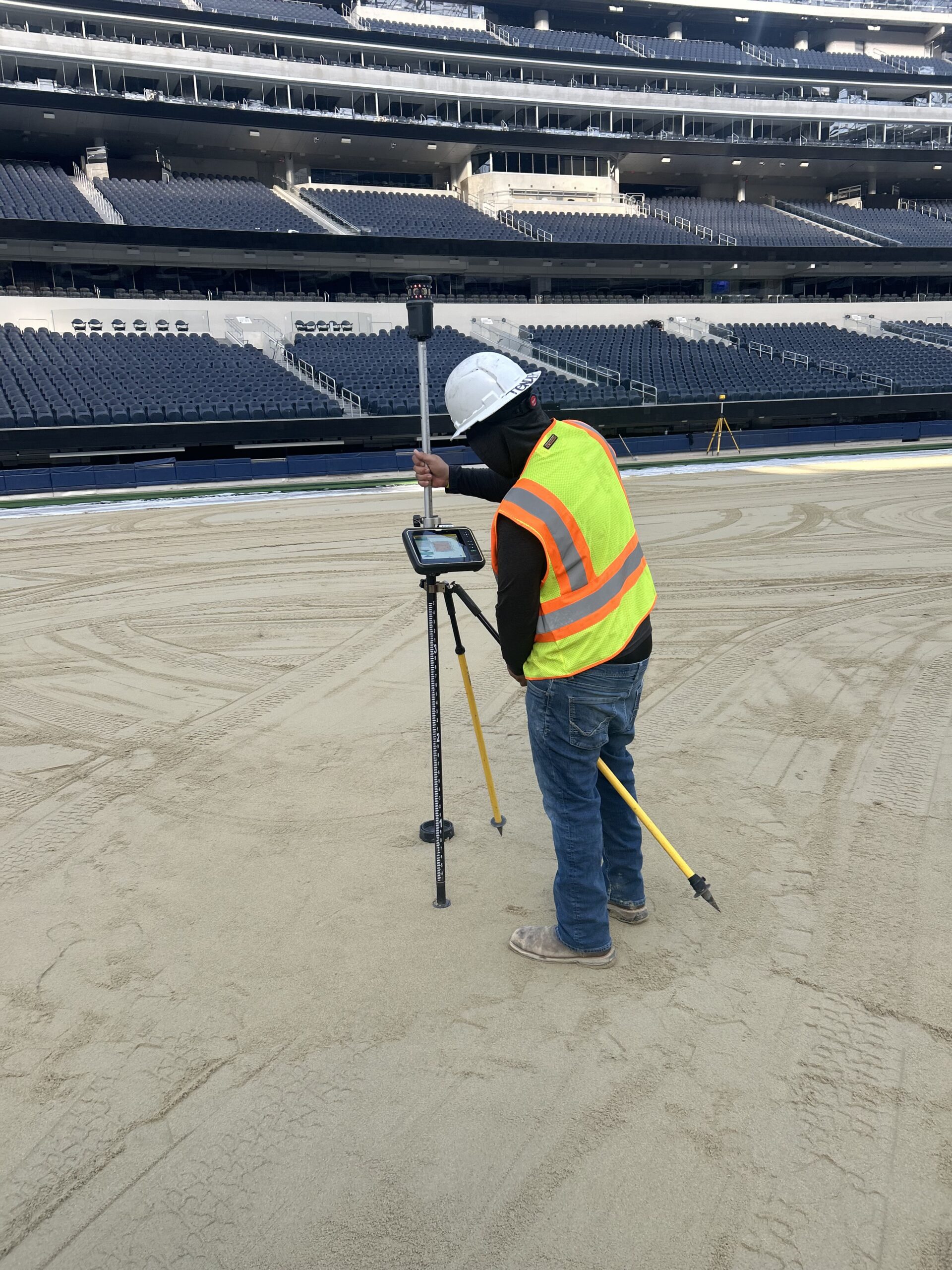
Our team at Advanced Sports Group is currently on site at a major stadium in Los Angeles, consulting on a massive natural turf remediation project in preparation for the 2026 World Cup. Over the past few days, the heavy machinery has rolled in, and the critical work of establishing the foundation has begun. We are currently in the middle of the finish grading phase, and the precision required at this stage is unlike anything else in sports construction.
The Foundation of Planarity
As we discussed in our initial project announcement, the ultimate goal of this remediation is to achieve perfect planarity. For a World Cup match, the surface must be absolutely flat and even. There is zero tolerance for dips, crowns, or uneven slopes that could alter the trajectory of a pass or create an unsafe footing condition for the athletes. That planarity does not come from the sod itself. It comes from the dirt beneath it. Right now, crews are working across the massive expanse of the stadium floor, moving and shaping the subgrade material. This is a highly technical process. We are not just pushing dirt around to make it look flat to the naked eye. We are using advanced laser grading technology and precision surveying equipment to measure the surface down to the millimeter.
If you look at the photos and videos coming from the site this week, you will see a mix of heavy equipment and highly sensitive technology working in tandem. Tractors equipped with laser-guided box blades are making continuous passes across the field. These blades automatically adjust their height based on signals received from a central laser transmitter, shaving off high spots and filling in low spots with incredible accuracy.
The finish grading phase is the unsung hero of sports construction. It is dusty, it is technical, and it lacks the immediate visual impact of rolling out bright green turf. But it is the foundation upon which everything else is built. Once the lasers have done their job and the surveying equipment confirms that the subgrade is perfectly planar, the site will be ready for the next major milestone: the arrival of the natural turf. Laying thick-cut sod across a stadium of this size is a massive logistical challenge, and the installation crews will be relying on the flawless finish grade we are establishing right now to ensure the seams are tight and the surface integrates perfectly.