
Our team at Advanced Sports Group is currently on site at a major stadium in Los Angeles, consulting on the natural turf remediation project. As we move closer to the sod installation phase, VP of Special Projects, Pete Fox, provides an update on two critical components of the process: 3D scanning for planarity and the science of moisture management.
The Digital Scan: Verifying Planarity
In our previous update, we discussed the finish grading phase, where laser guided equipment is used to establish a perfectly flat subgrade. But how do we know when the grade is truly perfect?
The answer lies in 3D scanning technology. “Today we will be doing a planarity test, a digital scan if you will, of the entire field,” Fox explains from high above the stadium floor. “It will tell us whether it is to the spec grade or not. It is very precise.” This 3D scan is a critical quality control measure. It maps the entire surface of the field, generating a detailed topographical model that highlights any microscopic deviations from the required grade. The results are delivered as comprehensive data sheets, allowing the team to identify and correct even the smallest imperfections. “After that is passed, it will be sod ready,” Fox notes. There is zero tolerance for error. The surface must pass the digital scan before a single roll of natural turf is laid.
The Edge Work: Seamless Integration
While the 3D scan verifies the overall planarity of the field, the team is also focused on the critical transition areas. The natural turf must integrate seamlessly with the existing synthetic turf collar that surrounds the playing surface. “Today we are going to work around the edges to make sure that it matches the sod elevation and the synthetic turf collar,” Fox says, as crews use straightedges and plate compactors to manually level the sand base along the perimeter. This meticulous edge work ensures that there are no lips, dips, or tripping hazards where the two surfaces meet. The goal is a continuous, safe, and visually perfect transition.
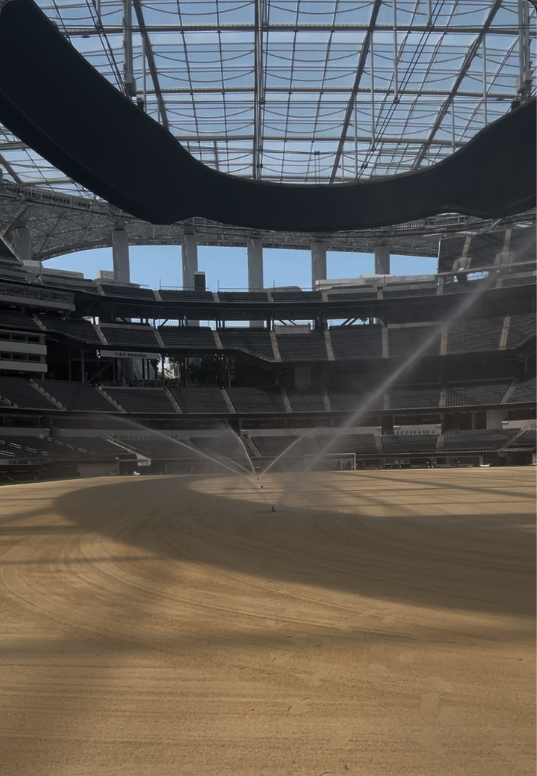
A natural turf field is a living system, and its success depends heavily on the foundation it is built upon. In this case, the foundation is a specialized sand base. “One of the key things of natural base fields is water,” Fox explains from the stadium floor, as a row of sprinklers actively sprays the sand. “Water settles in the sand, right? The moisture is very important, so we are constantly watering, keeping this sand from drying out.” Maintaining the correct moisture level in the sand base is essential for several reasons. First, it helps to stabilize the sand, preventing it from shifting or blowing away before the sod is installed. Second, it prepares the environment for the living grass. “Then it will be sod ready, and the water will go on immediately after the grass is laid and stay on to make sure that the plant lives and comes out of shock,” Fox adds.
The combination of 3D scanning, precise edge work, and careful moisture management represents the final, critical steps before the natural turf arrives. The dirt work is complete, the foundation is verified, and the environment is primed. The next time you see an update from the Fox Report, the stadium floor will look very different. The green is coming.
We are sharing daily updates, photos, and videos directly from the field in Los Angeles here: link to our blog.
Ready to build your own field? Whether it is a high school stadium or a community sports complex, the principles of building quality remain the same.